



Hi there! If you live in Florida, you’re well aware that our weather is anything but predictable. We’ve got the sunshine, the humidity, and, most importantly for your home’s electronics, we have more lightning than almost anywhere else in the country. In fact, Florida is often called the "Lightning Capital of the World."
Because of this, many homeowners find themselves asking: Do I really need a whole house surge protector, or is it just another sales pitch?
At Florida Electrical Specialists, we deal with the aftermath of power surges every single day. Whether it's a 24 hour electrician responding to a blown panel or a family realizing their brand-new HVAC system has fried after a afternoon thunderstorm, the reality is that surges are a constant threat in the Sunshine State.
In this guide, we’re going to give you the straight truth about whole-house surge protection. We’ll look at the data, the local building codes, and why the "power strip" approach might be leaving your biggest investments at risk.
What Exactly is a Whole House Surge Protector?
Before we dive into the "why," let's talk about the "what." Most people are familiar with the plastic power strips you buy at the big-box store to plug in your TV or computer. A whole-house surge protector (technically known as a Surge Protective Device or SPD) is a different beast entirely.
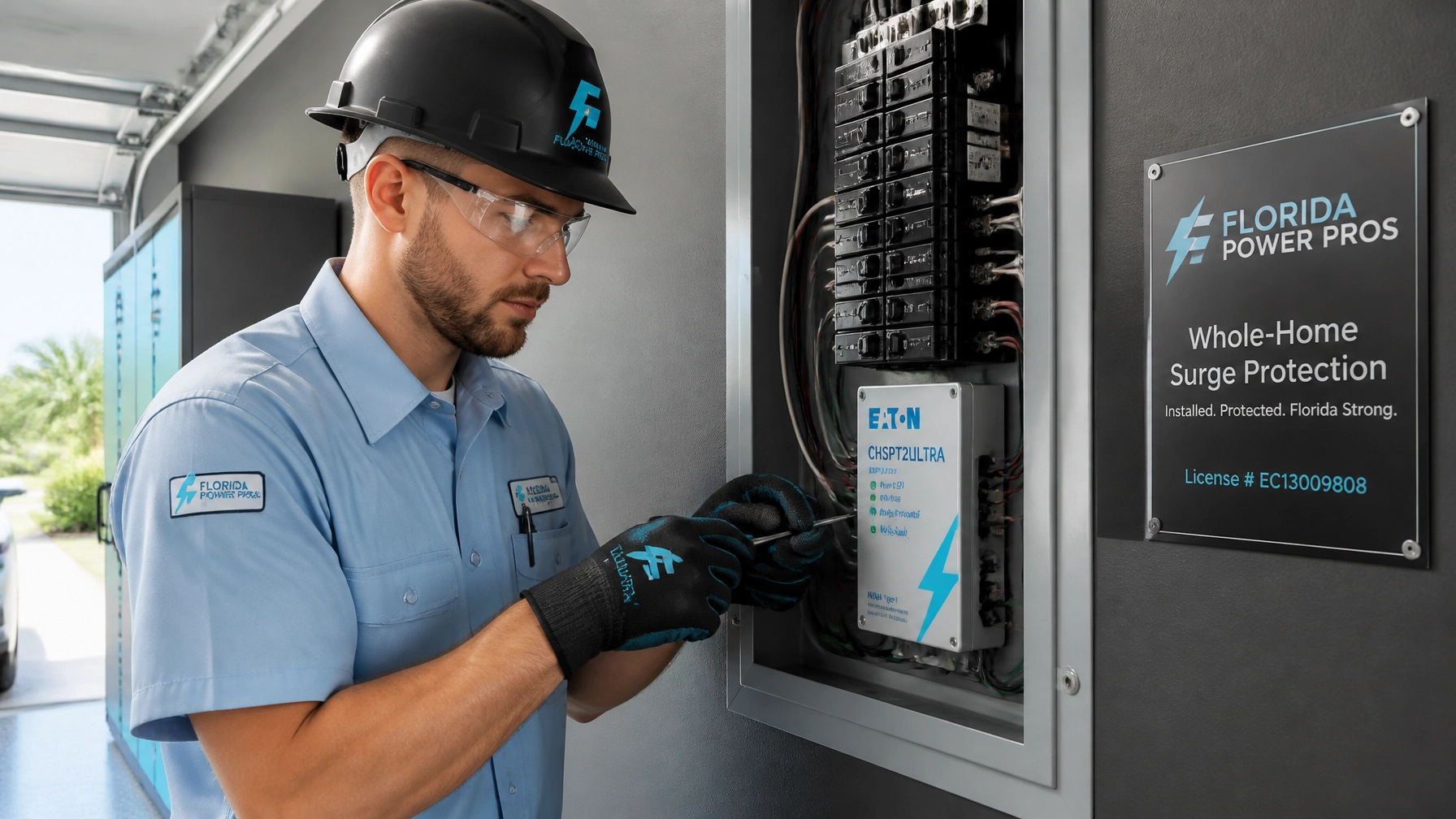
Instead of sitting behind your couch, this device is installed directly into your main electrical panel. Its job is to act as a gatekeeper for your entire home. When a massive spike in voltage hits your lines, whether from a lightning strike or a utility company mishap, the SPD detects the excess energy and safely diverts it into the ground before it can enter your home’s internal wiring.
The Two-Stage Defense
For the best protection, experts recommend a "layered" approach:
- Type 1 or Type 2 SPD: This is the whole-house unit installed at your panel. It handles the "big" surges.
- Type 3 SPD: These are your point-of-use power strips. They handle the smaller, internal surges that happen when large appliances (like your AC) kick on and off.
If you’re searching for an electrician near me to help secure your home, they will likely recommend this dual-layered strategy to ensure nothing gets through the cracks.

The "Florida Factor": Why Our State is Different
You might get away without a surge protector in a place like San Diego, but Florida is a different story. According to the Insurance Information Institute, Florida consistently leads the nation in lightning-related insurance claims. We aren't just talking about a few hundred dollars for a new toaster; we're talking about thousands of dollars in damage to home systems.
Lightning Capital Risks
Florida has one of the highest lightning flash densities in the U.S. That means more lightning strikes per square mile than almost anywhere else. While a direct hit on your roof is rare, a "near miss" can be just as devastating. A strike several houses away can travel through power, phone, or cable lines and enter your home, frying everything from your GFCI outlet installation to your refrigerator’s control board.
Utility Grid Fluctuations
It’s not just the storms. Our power grid is under constant stress from high demand (hello, 24/7 air conditioning!). When the power flickers or the utility company switches grids to handle the load, it creates "dirty power" or transient surges. Over time, these mini-spikes degrade the sensitive microchips in your modern appliances, shortening their lifespan significantly.
Is It Now the Law in Florida? (The NEC 2020 Update)
Here is a piece of information that surprises many homeowners: for many of you, a whole-house surge protector is no longer optional, it’s a requirement.
The 2020 National Electrical Code (NEC), which has been adopted across Florida, introduced Article 230.67. This rule states that all new and replaced "dwelling unit services" must have a surge protective device installed.
What does this mean for you?
- New Construction: If you are building a home, it must have an SPD.
- Electrical Panel Replacement: If you are doing an electrical panel replacement because your old one is outdated or damaged, your electrician is legally required to install a surge protector as part of the job.
- Upgrades: If you’re performing an electrical panel upgrade to increase your home's capacity (perhaps for a new pool or an EV charger installation), you will likely need to add an SPD to meet current safety codes.
Even if you aren't currently planning a panel project, adding an SPD is a smart move to bring your home up to modern safety standards.

Protecting Your Biggest Investments
Think about everything in your house that uses a circuit board. It’s not just your phone and laptop anymore. Today, almost everything is "smart."
- HVAC Systems: Modern air conditioners use expensive inverter boards that are highly sensitive to voltage spikes.
- Kitchen Appliances: Your smart fridge, oven, and dishwasher are essentially computers that happen to keep things cold or hot.
- EV Chargers: If you’ve invested in an electric vehicle, a surge through your charging station could damage the car’s battery system, a repair that can cost tens of thousands.
- Smart Home Hubs: Security cameras, smart locks, and lighting systems are all vulnerable.
When you weigh the cost of a whole house surge protector against the cost of replacing a $6,000 HVAC compressor, the investment pays for itself the very first time a storm rolls through your neighborhood.
Common Signs Your Home is Experiencing Surges
Often, homeowners don't realize they have a surge problem until it’s too late. Keep an eye out for these warning signs:
- Flickering or Dimming Lights: This often indicates a struggle with voltage consistency.
- Circuit Breaker Keeps Tripping: If your circuit breaker keeps tripping without a clear cause, it could be responding to external spikes.
- Frequent Bulb Burnouts: If you feel like you’re replacing light bulbs every other month, "dirty power" might be the culprit.
- Digital Clocks Resetting: If you wake up and the microwave is flashing "12:00" but there wasn't a full power outage, you likely had a transient surge.
- Outlet Not Working: Sometimes a surge can "pop" a specific outlet or a GFCI, leaving an outlet not working and requiring a professional repair.

Professional Installation: Why DIY Isn't an Option
We love a good DIY project as much as anyone, but surge protection is one area where you need a licensed professional. Installing a Type 2 SPD requires working inside the main service panel, where the "live" electricity enters your home. One slip can be fatal.
Furthermore, a surge protector is only as good as the grounding system it’s connected to. If your home’s grounding rod is corroded or improperly installed, the surge protector has nowhere to "send" the excess energy. A licensed emergency electrician from Florida Electrical Specialists will not just "plug in" a device; they will audit your entire grounding and bonding system to ensure the protection actually works when you need it most.
Conclusion: Is It Worth It?
So, back to the original question: Do you really need a whole house surge protector?
If you live in Florida, the answer is a resounding yes. Between our record-breaking lightning stats, the high cost of modern smart appliances, and the updated NEC code requirements, surge protection is no longer a luxury: it’s an essential part of home maintenance. It provides peace of mind that no matter how loud the thunder gets, your home’s electrical "brain" is shielded.
At Florida Electrical Specialists, we’ve resolved over 12,000 electrical issues for homeowners across the state. Whether you need a quick assessment of your current panel or are ready for a full electrical panel upgrade with integrated surge protection, we’re here to help. We offer 24-hour response times and clear, upfront estimates so there are never any surprises.
Don’t wait for the next big storm to find out if your electronics are protected.
Electrical requirements may vary by jurisdiction. Always consult local authorities or a licensed Florida electrical professional.
Ready to shield your home? Contact Florida Electrical Specialists today for a professional surge protection consultation. We serve all 67 counties in Florida with licensed, insured, and expert service.