



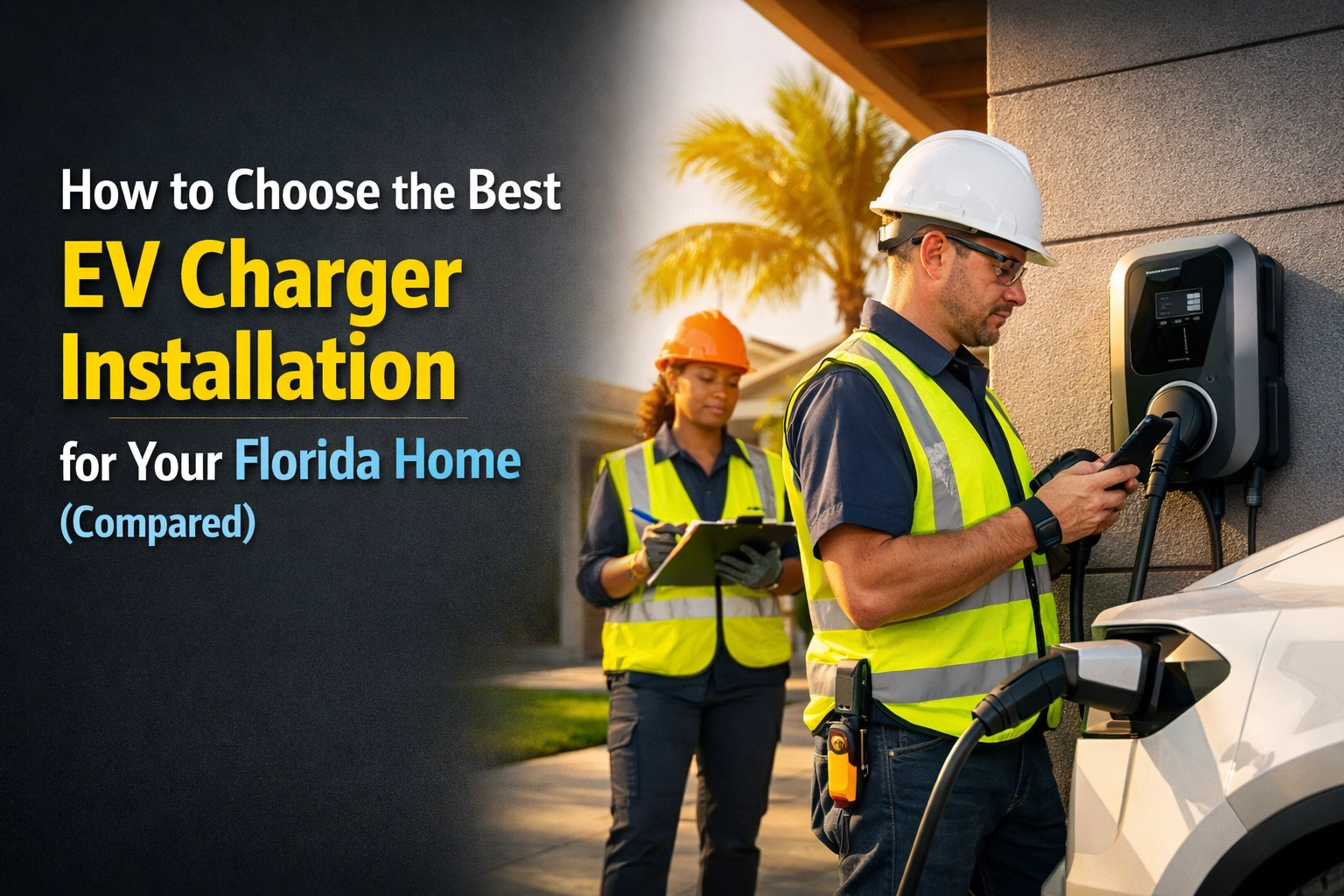
Hi there! Justin here, CEO of Florida Electrical Specialists. If you’ve recently traded in your gas-guzzler for a shiny new Electric Vehicle (EV), congratulations! You’re joining thousands of Floridians making the switch. But here is the thing: buying the car is the easy part. Deciding how to fuel it at home without blowing a fuse (literally) is where things get a bit more technical.
Choosing the right EV charger installation for your Florida home isn’t just about picking the coolest-looking box on Amazon. It’s about your daily commute, your home’s electrical capacity, and protecting your investment from our famous Florida afternoon thunderstorms.
In this guide, I’m going to break down the best chargers on the market for 2026, compare the installation requirements, and help you figure out if your current setup can handle the load. Let’s dive in!
Level 1 vs. Level 2: Which One Actually Works for You?
First, let’s clear up the jargon. You’ll hear "Level 1" and "Level 2" a lot.
- Level 1 Charging: This uses a standard 120-volt outlet not working? You just plug the cord that came with your car into a regular wall socket. It’s slow, really slow. We’re talking 3–5 miles of range per hour. If you only drive to the grocery store once a week, it might work. Otherwise, it’s a headache.
- Level 2 Charging: This is the gold standard for home installation. It requires a 240-volt circuit (the same kind your clothes dryer or oven uses). It delivers 25–50 miles of range per hour. For most of us in the Sunshine State, a Level 2 charger is a necessity, especially if you’re commuting across town or taking trips to Disney.

Top EV Charger Models Compared for 2026
There are dozens of chargers out there, but in my experience as a Florida electrician, a few stand out for reliability and ease of use. Here’s a quick comparison of the heavy hitters we see most often.
1. ChargePoint Home Flex
- Best For: All-around performance and smart features.
- Pros: It’s incredibly flexible (hence the name). You can set it to different amperages, and the app is one of the best in the business. It integrates well with utility rebate programs, which can save you serious cash.
- Cons: It’s on the pricier side, usually retailing between $550 and $750.
2. Emporia Level 2 Smart Charger
- Best For: Budget-conscious techies and solar-powered homes.
- Pros: This is a powerhouse for under $500. It offers fantastic energy monitoring so you can see exactly how much your car is adding to your electric bill. If you have solar panels, it can even be set to charge only when your panels are producing excess energy.
- Cons: The hardware feels a bit more "plastic-y" than the ChargePoint.
3. Tesla Wall Connector
- Best For: Tesla owners (obviously).
- Pros: It’s sleek, relatively affordable (around $450), and the cable is thinner and easier to handle than most J1772 chargers.
- Cons: Until recently, it only worked with Teslas. While there is a "Universal" version now, it's more expensive.
4. Grizzl-E Classic
- Best For: No-frills durability.
- Pros: If you’re mounting your charger outside or in a messy workshop, this is the one. It’s built like a tank and doesn’t need a Wi-Fi connection to work.
- Cons: No "smart" features. You can't track your energy usage or schedule charging through an app.
The "Florida Factor": Why Installation Isn't Just "Plug and Play"
Down here, we have two things that chargers hate: heat and lightning.
Florida is the lightning capital of the U.S., and your EV is essentially a giant battery sitting in your garage. If a surge hits your home, it can fry your car’s sensitive electronics. That’s why we always recommend a whole house surge protector alongside any EV installation. It’s the best insurance policy you can buy for your home’s electrical system.

Is Your Electrical Panel Ready for the Load?
Before you click "buy" on that charger, we need to talk about your electrical panel. A Level 2 charger usually requires a 50-amp breaker. If your home was built more than 20–30 years ago, your panel might already be maxed out.
If you notice your circuit breaker keeps tripping when you run the AC and the microwave at the same time, adding an EV charger will definitely push it over the edge. In many cases, an electrical panel upgrade or a full electrical panel replacement is necessary to ensure your home stays safe.
Don't ignore the warning signs. If your lights flicker or the panel makes a buzzing sound, give us a call. We even offer 24 hour electrician services if things go south in the middle of the night.
Cost Breakdown: Equipment vs. Installation
I get asked about the price all the time. Here’s the reality for 2026:
- The Charger Unit: $350 – $800.
- The Permit: $50 – $300 (depending on your Florida county/municipality).
- The Installation Labor/Materials: $600 – $2,500.
Why is the installation range so wide? It depends on where your panel is located compared to where you park your car. If your panel is on the opposite side of the house from the garage, we have to run heavy-duty conduit through the attic or around the exterior, which adds to the cost.
Pro-tip for Realtors: Installing an EV charger is a massive selling point in today's market. If you're looking to boost a property's value, this is a "future-proof" upgrade that buyers love. Check out our guide on why an electrical panel upgrade will change the way you sell Florida homes.

Finding an "Electrician Near Me" Who Actually Knows EVs
You might be tempted to call a general handyman for this, but I strongly advise against it. EV charger installation isn't like putting in a ceiling fan. It involves high-voltage electricity running at a continuous load for hours every single night. If the connections aren't torqued perfectly or the wire gauge is wrong, it can lead to a fire.
When searching for an electrician near me, look for a team that:
- Understands Florida Building Codes.
- Is licensed and insured.
- Performs a "Load Calculation" before starting (this is crucial!).
- Offers a warranty on their work.
At Florida Electrical Specialists, we don't just "hook it up." We evaluate your whole system. From GFCI outlet installation for safety to ensuring your whole house surge protector and EV charger installation work in harmony, we handle the details so you can sleep soundly while your car charges.
Frequently Asked Questions (FAQ)
Q: Do I need a permit for an EV charger in Florida?
A: Yes. Most Florida municipalities require a permit for any new 240V circuit. This ensures the work is inspected and meets safety codes.
Q: Can I use a NEMA 14-50 outlet instead of hardwiring?
A: You can, but hardwiring is generally safer and allows for faster charging speeds (48-50 amps vs 40 amps). Plus, it eliminates a point of failure: the outlet itself can melt if it's not "EV-grade."
Q: What if I have an old home with aluminum wiring?
A: That’s a major safety concern. Before adding a high-draw appliance like an EV charger, you should read up on why aluminum wiring is a safety risk and have a professional inspection.

Final Thoughts: Ready to Power Up?
Choosing the best EV charger for your Florida home comes down to your driving habits and your home’s "electrical health." Whether you go with the high-tech ChargePoint or the rugged Grizzl-E, the most important step is ensuring the installation is done correctly and safely.
Don't risk your new car or your family’s safety with a DIY job or an unlicensed "trunk-slammer." Florida Electrical Specialists is here to help homeowners, realtors, and contractors navigate the complexities of modern electrical needs.
Note: Electrical requirements may vary by jurisdiction. Always consult local authorities or a licensed Florida electrical professional before beginning work.
Ready to get started? Florida Electrical Specialists helps property owners navigate permits, inspections, and electrical code requirements statewide. Give us a call today and let's get your home ready for the future!
Have fun with your new EV! It’s a blast to drive: just make sure it’s a blast to charge, too.