



When your lights flicker at midnight, your circuit breaker keeps tripping, or an outlet isn’t working right before a showing, you don’t have time to “shop around” the normal way. You need an emergency electrician who can show up fast, fix the problem safely, and keep you on the right side of Florida codes and insurance requirements.
But here’s the tricky part: plenty of companies advertise “24/7” or “24 hour electrician,” and the real-world experience can vary a lot. Some dispatch quickly and communicate clearly. Others… don’t.
This guide compares what actually matters when choosing a 24-hour electrician near you in Florida, so homeowners, realtors, and contractors can make a smart call under pressure (without rolling the dice on safety).
Electrical requirements may vary by jurisdiction. Always consult local authorities or a licensed Florida electrical professional.
What counts as a real electrical emergency in Florida?
Not every electrical issue needs a midnight visit, but many do, especially in Florida where heat, humidity, storms, and older housing stock can stress electrical systems.
Call an emergency electrician right away if you notice:
- Burning smell, smoke, sizzling, or buzzing from a panel, outlet, switch, or ceiling fixture
- Hot outlets or warm wall plates (especially with discoloration)
- Power loss to part of the home with no utility outage reported
- Repeated breaker trips (especially if it trips immediately after reset)
- Water intrusion near wiring, outlets, or the electrical panel (post-storm leaks are common)
- Sparking at outlets or when plugging something in
- A fallen service line or damaged meter equipment (keep your distance and call the utility first)
Usually not a “right now” emergency (but still worth scheduling soon):
- One outlet not working (unless it’s hot, smoking, or sparking)
- A GFCI that keeps tripping but resets and holds
- A single flickering bulb on one fixture (could be the bulb/fixture, but still worth checking)
If you’re unsure, treat it like an emergency, especially if there’s heat, smell, or noise.
The 24-hour electrician comparison checklist (what to ask before they roll)
When you’re searching “electrician near me” at 1:00 a.m., you’re not looking for a fancy website, you’re looking for proof. Use this comparison checklist on the phone (or even via text) to quickly sort the pros from the pretenders.
1) Licensing & insurance (non-negotiable)
In Florida, you want a properly licensed electrical contractor and an insured company, especially for emergency work where risks are higher.
Ask:
- “What’s your Florida license number?”
- “Are you insured for general liability and workers’ comp?”
- “Will your technician on site be working under that license?”
Why it matters:
- Licensed contractors are accountable to state requirements and typically follow current National Electrical Code (NEC) standards as adopted and enforced locally.
- Insurance protects you if there’s accidental property damage or injury during the emergency call.
Optional due diligence (worth doing if you have a minute):
- Verify licensing via Florida’s DBPR: https://www.myfloridalicense.com/
2) Real 24/7 dispatch (not “we answer tomorrow”)
Some companies market 24/7 but only schedule after-hours calls, or they charge extreme premiums to discourage night work.
Ask:
- “Do you have a technician available right now, or are you taking messages?”
- “What’s your average response time in my area?”
- “Do you dispatch in-house techs or subcontract?”
What “good” looks like:
- Clear dispatch communication, a realistic ETA, and updates if anything changes.
3) Upfront pricing (so you don’t get surprise-billed at 2:30 a.m.)
Emergency work costs more, it’s the surprise fees that sting.
Ask:
- “Is there a flat emergency dispatch fee?”
- “Is it hourly or flat-rate after diagnosis?”
- “Do you charge extra for nights/holidays?”
- “Will I get an estimate before you start repairs?”
Red flags:
- Refuses to discuss pricing structure at all
- Won’t provide any estimate range until the job is done
- Pushes you to approve major work immediately without explaining options
4) Florida permitting and inspection awareness
Many emergency repairs can be made safely right away, but some work may require a permit and inspection (especially anything involving service equipment, panel replacement, or new circuits). Requirements can vary by city/county.
Ask:
- “If this turns into a panel repair or replacement, do you handle permitting?”
- “Will the repair be documented for insurance or a future inspection?”
This is especially relevant for realtors and contractors dealing with:
- 4-point inspections
- insurance renewals
- closing timelines
Helpful reading if you suspect panel issues:
- Is your electrical panel outdated? What to look for
- Electrical panel replacement vs upgrade: what Florida pros need to know
5) Communication and documentation (especially for realtors/contractors)
When an emergency happens on a job site or before a showing, the fix is only half the job, documentation is the other half.
Ask:
- “Can you send photos and a written summary of the issue and repair?”
- “Will you identify whether this is a temporary fix or a permanent repair?”
- “Can you coordinate with property management/tenants?”
Side-by-side: how different 24-hour electricians stack up
Use this comparison to quickly evaluate who you’re hiring.
| Category | Best choice looks like | Watch out for |
|---|---|---|
| Licensing & insurance | Florida license # provided, insured, accountable | “We’re licensed” but no number, vague insurance |
| Response time | Real ETA + updates, true 24/7 dispatch | “We’ll call you back,” no timeframe |
| Troubleshooting | Explains likely causes + tests on site | Diagnoses from the driveway, guesses |
| Pricing | Clear emergency fee + estimate before work | Surprise add-ons, pressure tactics |
| Code awareness | Talks permits/inspection when needed | “No permit ever needed” (not true) |
| Work quality | Safe repairs, proper parts, labeled work | Quick patch that fails next week |
| Follow-up | Recommends next steps, safety checks | Disappears after collecting payment |
What a great emergency electrician does on arrival (and why it matters)
A professional emergency response isn’t just “swap a breaker and go.” In Florida homes, underlying causes can include corrosion, loose terminations, aging panels, storm-related water intrusion, or undersized circuits for modern loads.
Expect a solid emergency electrician to:
- Make the scene safe
- Shut down affected circuits
- Check for heat damage and arcing risks
- Confirm the problem with testing (not guessing)
- Verify voltage, load, and fault conditions
- Inspect outlets/switches/panel as needed
- Explain what failed and why
- “The breaker is tripping because the circuit is overloaded” vs. “It’s just a bad breaker”
- Offer options
- Temporary stabilization (when appropriate)
- Permanent repair path, including whether permitting is likely needed
- Document the work
- Notes and photos are gold for insurance, inspections, and real estate transactions
Common emergency calls in Florida, and what they usually point to
“My circuit breaker keeps tripping”
This one is huge. Common causes include:
- Overloaded circuit (portable AC units and garage fridges are frequent culprits)
- Short circuit or ground fault
- Failing breaker (less common than people think)
- Loose connection creating heat (serious)
If your breaker trips repeatedly, avoid the “keep resetting it” loop. That’s how overheated wiring turns into a real hazard.
Related reading: Protecting your family: when to call an electrician
“An outlet is not working”
Before you panic: many “dead outlets” are caused by a tripped GFCI upstream (sometimes in a garage, bathroom, or outside).
But call immediately if:
- The outlet is hot, discolored, or smells burnt
- There’s sparking
- The outlet stopped working after water exposure
If you’re upgrading safety in kitchens, garages, outdoors, or near water, ask about GFCI outlet installation (GFCI protection is required in many locations and is one of the best safety upgrades you can make).
“We lost power to half the house”
Often points to:
- A tripped main or feeder breaker
- A failed connection in the panel
- A utility-side issue (especially after storms)
- A damaged service or meter base (utility involvement may be required)
“We had a surge and now weird stuff is happening”
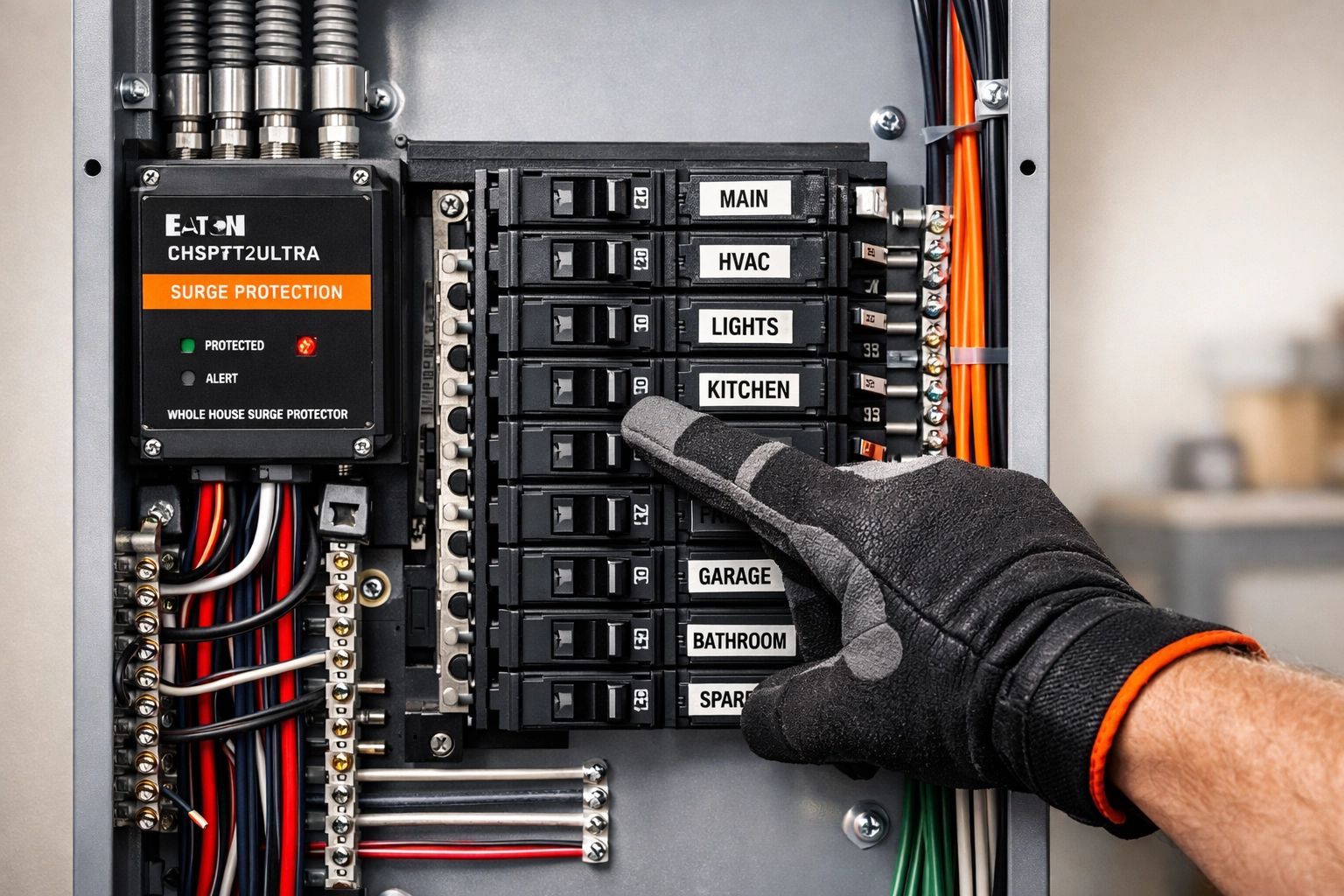
Florida storms can be brutal on electronics and appliances. If you’ve had multiple devices fail, ask your electrician about adding a whole house surge protector at the panel.
More: Why Florida homes need whole-home surge protection
Questions to ask during the call (copy/paste script)
If you want a quick way to screen a 24-hour electrician, here’s a script that works:
- “Are you a licensed Florida electrical contractor? What’s your license number?”
- “Are you insured (general liability and workers’ comp)?”
- “Do you have a technician available now? What’s the ETA to [your city/neighborhood]?”
- “Is there an emergency service fee and how do you price repairs after diagnosis?”
- “Will I receive an estimate before work begins?”
- “If this involves a panel repair/replacement or new circuit, can you help with permits?”
- “Can you send photos and a written summary for my records?”
Choosing a 24-hour electrician for specific situations (homeowners vs. realtors vs. contractors)
Homeowners: prioritize safety + long-term fix
If your home has older electrical components (common across many Florida neighborhoods), emergency calls can reveal bigger issues like undersized panels or unsafe wiring.
If the electrician mentions panel concerns, these posts can help you ask better questions:
- 5 warning signs your Florida home needs rewiring now
- Why aluminum wiring is a safety risk for your home
Realtors: prioritize documentation + inspection readiness
You want:
- Clear invoice line items
- Photos of the issue and repair
- Notes on whether additional work is recommended before closing
Panel concerns can impact insurability and negotiations, so a contractor who understands that reality is a big win.
Contractors: prioritize coordination + code-aware repairs
On job sites, after-hours electrical issues can stall schedules. Look for a 24-hour electrician who:
- Can coordinate with your superintendent/project manager
- Understands when permitting is needed
- Can return for planned corrective work (not just emergencies)
Red flags: signs you should call someone else
- They won’t share a license number or proof of insurance
- They quote a price without asking any questions and without inspecting anything
- They pressure you into a full electrical panel replacement on the spot without diagnosis
- They suggest bypassing safety devices (GFCI/AFCI) to “stop nuisance trips”
- They can’t explain what failed in plain English
- They won’t provide any receipt or written scope of work
FAQ: 24-hour electrician calls in Florida
Do I need to shut off the main breaker?
If there’s smoke, burning smell, sizzling, or visible damage, yes, if it’s safe to access the panel. If you see fire or heavy smoke, leave and call 911.
Is it safe to use extension cords temporarily?
Only as a short-term measure and only if they’re heavy-duty and not run under rugs/doors. Extension cords are a common source of overheating.
If my GFCI outlet keeps tripping, is that dangerous?
It can be. A GFCI trips for a reason: moisture, a wiring fault, or a failing appliance. Don’t ignore it, especially in Florida’s humid environments.
Can an emergency electrician do a panel upgrade at night?
Sometimes an electrician can stabilize the situation after-hours, but a full electrical panel upgrade may require coordination with the utility, permitting, and inspection depending on your jurisdiction and scope. A good electrician will explain what can be done immediately versus what should be scheduled.
Bottom line: the best 24-hour electrician is the one who’s fast and accountable
When you need an emergency electrician, speed matters: but so do licensing, safe troubleshooting, transparent pricing, and Florida code awareness. If you compare electricians using the checklist above, you’ll avoid the most common after-hours mistakes: rushed repairs, surprise invoices, and unsafe “band-aid” fixes.
If you’re in Florida and need a 24 hour electrician who can respond quickly and keep the work clean, documented, and code-conscious, Florida Electrical Specialists can help: whether it’s a breaker that won’t stop tripping, an outlet not working, a suspected panel issue, or surge protection planning.