



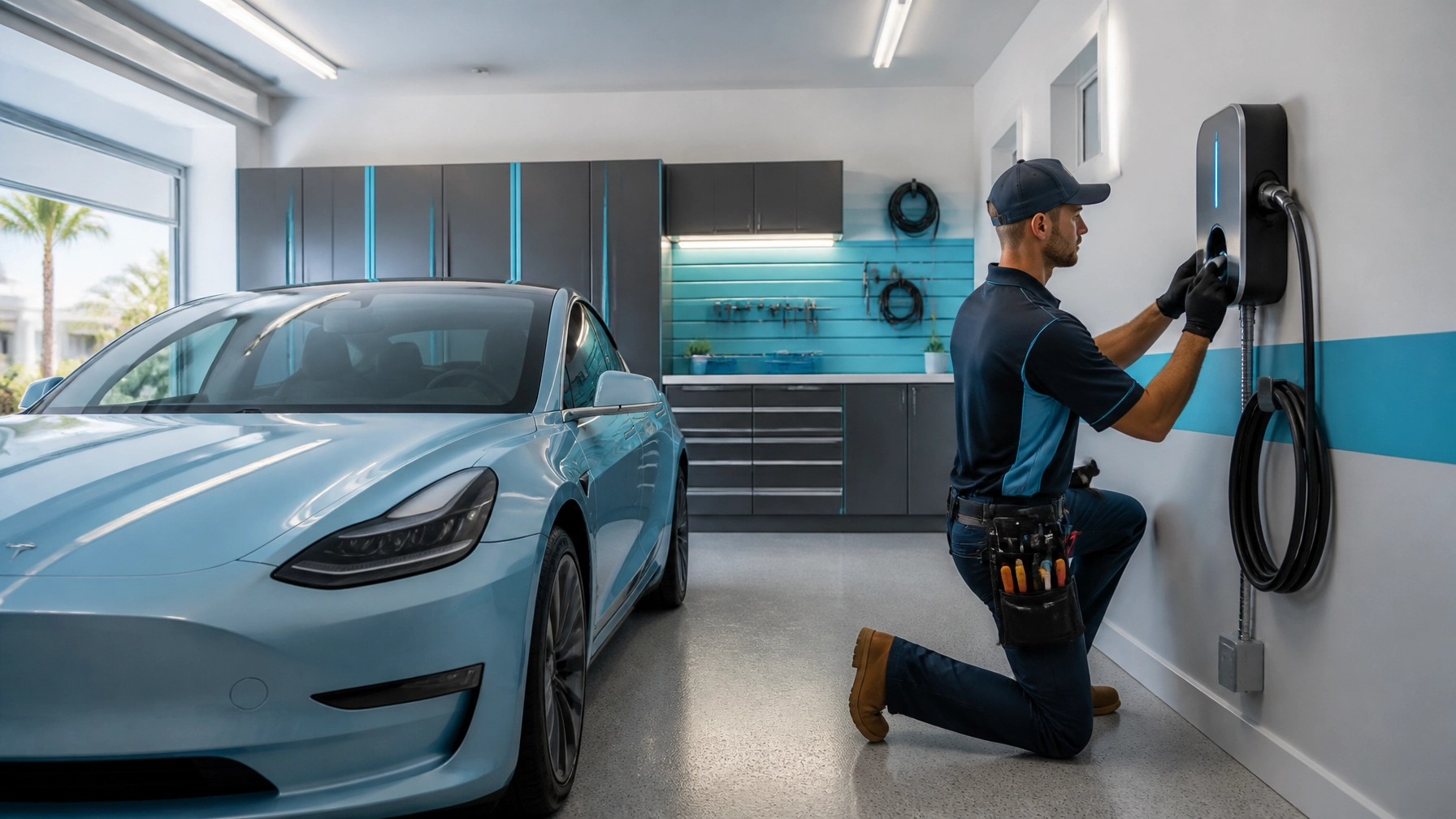
If you’ve recently made the switch to an electric vehicle (EV) or you’re currently eyeing that shiny new Tesla, Rivian, or Ford F-150 Lightning, you’re part of a massive movement across the Sunshine State. Florida currently ranks second in the nation for EV registrations, and it isn’t hard to see why. Between our expansive highways and the growing infrastructure, Florida is a paradise for electric driving: provided you aren’t tethered to a public charging station.
While public chargers are great for road trips down to the Keys or up to the Panhandle, relying on them for your daily commute is like living in a house without a kitchen and eating every meal at a gas station. It’s expensive, inconvenient, and time-consuming.
A professional EV charger installation at your home is the single biggest upgrade you can make to your driving experience. In this guide, we’ll dive into why home charging is a game-changer, the technical requirements you need to know (including why you might need an electrical panel upgrade), and how Florida’s unique climate impacts your setup.
1. The Ultimate Convenience: Wake Up with a "Full Tank"
The most immediate change you’ll notice after a professional EV charger installation is the "smartphone" lifestyle. Just like you plug your phone in at night and wake up to 100% battery, your car does the same.
Most EVs come with a "Level 1" charger: a simple cord that plugs into a standard 120V wall outlet. In Florida, where we drive long distances, Level 1 charging is often frustratingly slow, adding only about 3–5 miles of range per hour. If you have a long commute from Pasco County to Tampa, a standard outlet simply won’t cut it.
By upgrading to a Level 2 charger (240V), you can fully charge most vehicles in 4 to 8 hours. This means no more detouring to a public charger after work or sitting in a parking lot for 45 minutes just to get enough juice to get home.
2. Slashing Your "Fuel" Costs
Charging at home in Florida is significantly cheaper than buying gasoline or even using public DC fast chargers. According to data from FPL and other Florida utilities, home charging can lower your "per mile" cost by 50% to 75% compared to internal combustion engines.
Furthermore, Florida residents can often take advantage of programs like FPL EVolution. These initiatives sometimes offer fixed monthly rates for equipment and installation, or specialized "time-of-use" rates that make it incredibly cheap to charge your car between midnight and 6:00 AM.
When you work with a licensed electrical contractor in Florida, we can help ensure your system is set up to take full advantage of these local utility savings.

3. The Technical Reality: Does Your Panel Have the Muscle?
One of the most common questions we hear is: "Can I just plug my charger in and go?"
The answer depends entirely on your home’s current electrical capacity. A Level 2 EV charger typically requires a dedicated 40-amp to 60-amp circuit. For many older homes in Florida: especially those built before the late 1990s: the existing electrical panel may already be near its limit.
Is an Electrical Panel Upgrade Necessary?
Adding a high-load appliance like an EV charger to an older system can lead to a circuit breaker keeps tripping situation, or worse, overheating. Before installation, a licensed electrician near you must perform a Load Calculation (per NEC Article 220). This ensures your home can handle the 7,000 to 11,500 watts an EV charger demands without risking a fire.
If your panel is full or undersized, an electrical panel upgrade or a full electrical panel replacement isn't just a hurdle: it’s an investment in your home’s safety and resale value. A 200-amp service is the modern standard for EV-ready homes.
Note: If you are a realtor or property manager, having an EV-ready garage is a massive selling point in the current Florida market. We often work with real estate professionals to perform pre-sale electrical assessments and upgrades.
4. Safety and Florida Building Codes
In Florida, electrical work isn't just about making things work; it’s about making things legal and safe. The Florida Building Code and the National Electrical Code (NEC) Article 625 have very specific requirements for EV power transfer systems.
GFCI Protection
Recent updates to the NEC require GFCI outlet installation (Ground Fault Circuit Interrupter) for EV charging receptacles. This is critical in Florida, where humidity and garage moisture are constant factors. A properly installed GFCI protection ensures that if water ever interferes with the connection, the power is cut instantly to prevent shocks.
Proper Permitting
Never let an unlicensed "handyman" install your charger. In Florida, this work requires a permit and a subsequent inspection by the local municipality. Whether you are in Wakulla County or Leon County, failing to have a permitted installation can lead to insurance claim denials and issues during home inspections when you try to sell.

5. The Florida Factor: Lightning and Surges
Florida is the "Lightning Capital of the U.S." This presents a unique risk for EV owners. Your electric vehicle is essentially a massive, expensive computer on wheels. A nearby lightning strike can send a massive voltage spike through your home’s wiring, potentially frying your car’s sensitive onboard charging electronics.
When we perform an EV charger installation, we almost always recommend a whole house surge protector.
While the charger itself may have some internal protection, a whole-house unit at the main panel provides a primary line of defense. It protects not just your car, but your entire home’s electrical system from the frequent surges we experience during Florida’s summer afternoon thunderstorms.
6. Common Issues: What to Do if Things Go Wrong
Even the best systems can run into hiccups. If you notice an outlet not working in your garage or your new charger is frequently losing power, it’s time to call in the pros.
Electrical issues in a high-voltage EV circuit are not DIY projects. If you smell burning plastic near your panel or see charred marks on your charging port, you need an emergency electrician. At Florida Electrical Specialists, we offer 24 hour electrician response times for urgent safety issues, ensuring your home and vehicle stay protected around the clock.

Conclusion: Future-Proofing Your Florida Home
Installing an EV charger is about more than just convenience: it’s about taking control of your energy and future-proofing your most valuable asset. By moving away from the gas pump and toward a dedicated home charging station, you’re choosing a cleaner, cheaper, and more efficient way to navigate the Sunshine State.
From ensuring your panel can handle the load to protecting your investment with surge protection, Florida Electrical Specialists is here to handle every step of the process. We are electrical and permit experts who ensure all work meets Florida’s stringent electrical codes, giving you peace of mind with every mile you drive.
Ready to change the way you drive?
Whether you need a quick consultation, a GFCI outlet installation, or a full electrical panel replacement to get EV-ready, our team of licensed pros is ready to help.
Disclaimer: Electrical requirements may vary by jurisdiction. Always consult local authorities or a licensed Florida electrical professional before beginning any high-voltage installation.