



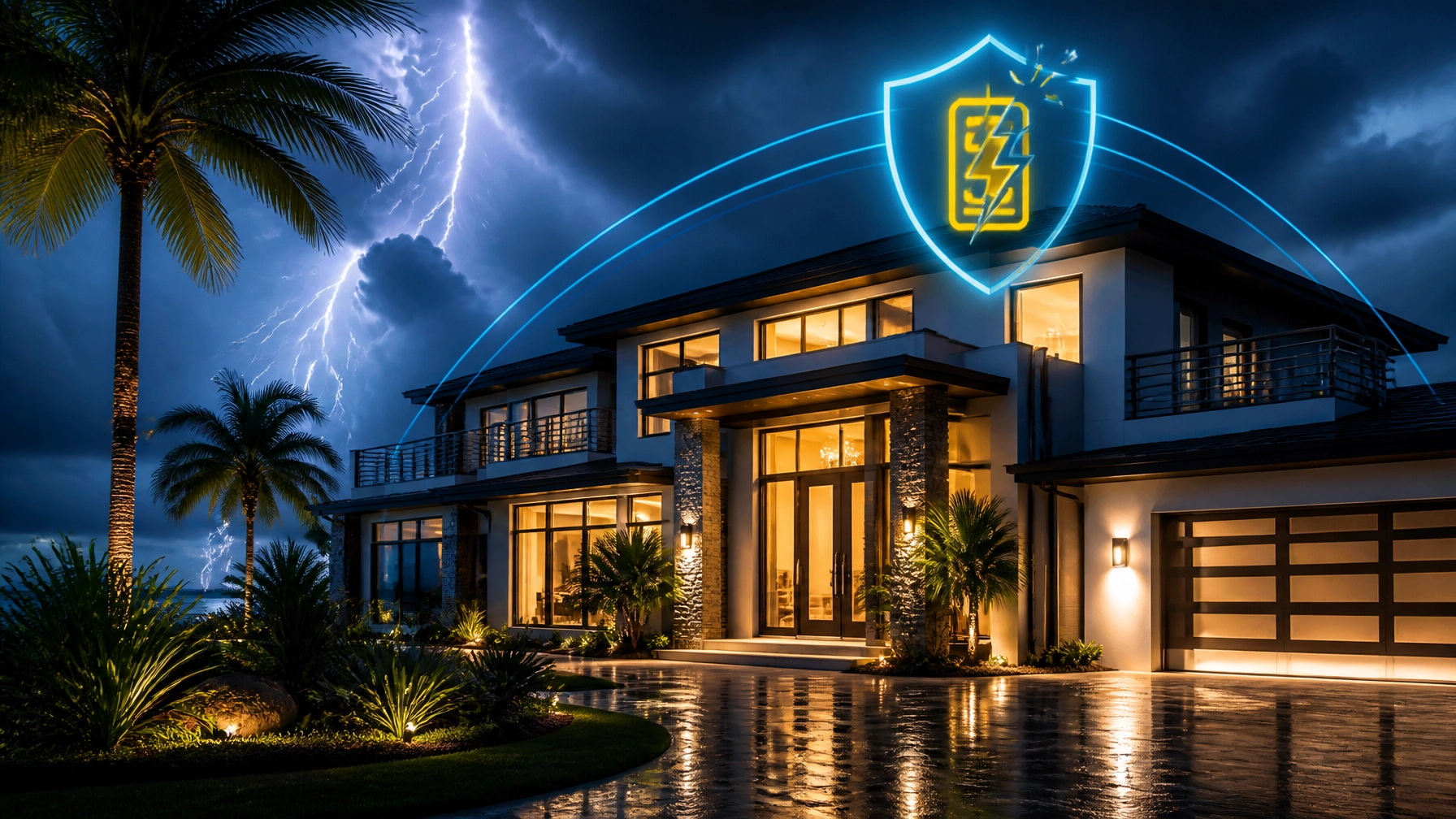
Hi there! If you’ve lived in Florida for more than a single summer, you know the drill. The sky turns a bruised purple, the wind starts whipping the palm trees, and suddenly: BOOM: the "Lightning Capital of the US" lives up to its name.
As a homeowner, your first instinct is usually to make sure the windows are shut and the dog isn’t hiding under the sofa. But have you ever stopped to think about what all that electricity is doing to your home’s "nervous system"? We're talking about your expensive 4K TV, your brand-new HVAC system, and even that EV charger installation you just put in the garage.
At Florida Electrical Specialists, we’ve resolved over 12,000 electrical issues across the state. We’ve seen firsthand what happens when a surge hits an unprotected home, and let’s just say it’s not a cheap fix.
So, do you really need a whole house surge protector? Let's dive into the truth, the code, and why Florida is a whole different ballgame when it comes to electrical safety.
What Exactly is a Whole House Surge Protector?
Think of a whole house surge protector (or a Surge Protective Device, SPD) as a security guard standing at the front door of your home’s electrical panel.
Most people are familiar with those cheap power strips you buy at big-box stores. While those are okay for a lamp or a toaster, they aren’t designed to handle the massive spikes of electricity that Florida storms can throw your way. A whole house surge protector is installed directly into your main electrical panel. Its job is to "clamp" or redirect excess voltage safely into the ground before it ever enters your home’s internal wiring.
When you're searching for an "electrician near me" to handle an installation, you're looking for someone who can mount a Type 1 or Type 2 SPD. These devices protect the "big stuff" that power strips can't touch, like your refrigerator, oven, and washer/dryer.

The "Florida Factor": Why Our State is Different
In some states, a surge protector is a "nice to have." In Florida, it's practically a survival tool for your appliances. According to the National Weather Service, Florida consistently leads the nation in lightning strike density. We’re talking about 1.2 million flashes per year.
Because our soil is sandy and we are surrounded by water, lightning and power surges are more frequent and more intense here than almost anywhere else in the world. In fact, Florida has the highest number of home insurance claims due to lightning in the U.S.
If you've noticed your circuit breaker keeps tripping after a storm, or you're dealing with an outlet not working, these are often signs that smaller, "silent" surges are already eating away at your electronics.
It’s Not Just a Recommendation: It’s the Law (Sort Of)
Here is the part that many homeowners don't realize: the rules have changed. The National Electrical Code (NEC), which sets the standard for safe electrical work across the country, updated its requirements in 2020.
Under NEC 2020 (Article 230.67), all new homes and even existing homes undergoing an electrical panel replacement or a significant electrical panel upgrade are required to have a whole-house surge protector installed.
Since Florida is currently following the latest versions of the Florida Building Code, if you call us for an emergency electrician service that requires a panel change, we have to install a surge protector to meet code. It’s for your safety and to ensure your home remains compliant with state regulations.
Protecting Your Modern "Smart" Home
Twenty years ago, the most expensive thing in your house was probably the microwave. Today, almost every appliance has a delicate computer chip inside.
- HVAC Systems: Modern AC units are highly sensitive to voltage fluctuations.
- EV Chargers: If you have an electric vehicle, a surge can fry the charging port or the car’s internal battery management system.
- Smart Appliances: Your fridge now has Wi-Fi and a touchscreen. A single surge can turn that $3,000 appliance into a giant paperweight.
Replacing these items is significantly more expensive than the one-time cost of a whole-home SPD. It’s about proactive protection rather than reactive repair.

The "Layered" Approach to Safety
One common myth we hear is: "If I have a whole house surge protector, I don't need power strips anymore, right?"
Actually, you need both! We recommend a "layered" approach:
- The Shield (Whole House SPD): Stops large external surges from the grid or nearby lightning strikes from entering the home.
- The Buffer (Point-of-Use Strips): Protects against smaller, internal surges created by your own appliances (like when the AC kicks on and causes a mini-spike).
- The Foundation (GFCI Outlets): Ensuring you have proper GFCI outlet installation in wet areas like kitchens and bathrooms adds another level of ground-fault protection.
By layering your defenses, you're creating a nearly bulletproof system for your home's electronics.
Is It Worth the Investment?
Let’s be real: budgeting for electrical work isn't as fun as budgeting for a new patio. But when you compare the cost of a surge protector to the deductible on your homeowner's insurance (or the cost of replacing a fried HVAC motherboard), the math is easy.
Most professionally installed whole-house surge protectors cost a fraction of what you’d pay for a single major appliance repair. Plus, many high-quality SPDs come with their own manufacturer’s warranty that covers connected equipment if the device fails.
When you work with Florida Electrical Specialists, you aren't just getting a part installed; you're getting experts who understand the specific demands of the Florida power grid. Whether you're in Leon County or down in Pasco County, we provide clear upfront estimates with no hidden fees.

The Florida Electrical Specialists Promise
We know that electrical issues don't always happen during business hours. That’s why we offer 24-hour response times for urgent issues. Whether you need a 24 hour electrician because your power is out after a storm or you're a realtor needing a pre-sale electrical assessment, we've got you covered.
Our team is fully licensed and insured, covering all 67 counties in Florida. We aren't just "handymen": we are permit experts who ensure every job meets the rigorous Florida electrical codes.
Why choose us?
- Statewide Coverage: We serve homeowners and contractors from the Panhandle to the Keys.
- Experience: Over 12,000+ electrical issues resolved.
- Reliability: Emergency and same-day service available.
- Transparency: Clear, upfront estimates.
The Verdict: Do You Need One?
If you live in Florida: Yes.
Between the frequency of lightning strikes and the updated NEC code requirements, a whole house surge protector is one of the smartest investments you can make for your property. It’s about peace of mind. When the next big thunderstorm rolls through: and we know it will: you can sit back and relax, knowing your home is guarded by the best tech in the business.
Ready to protect your home? Don't wait for the next storm to find out if your electronics can handle the heat. Contact Florida Electrical Specialists today for a professional assessment and ensure your home is up to code and fully protected.
Disclaimer: Electrical requirements may vary by jurisdiction. Always consult local authorities or a licensed Florida electrical professional like Florida Electrical Specialists before performing electrical work.