



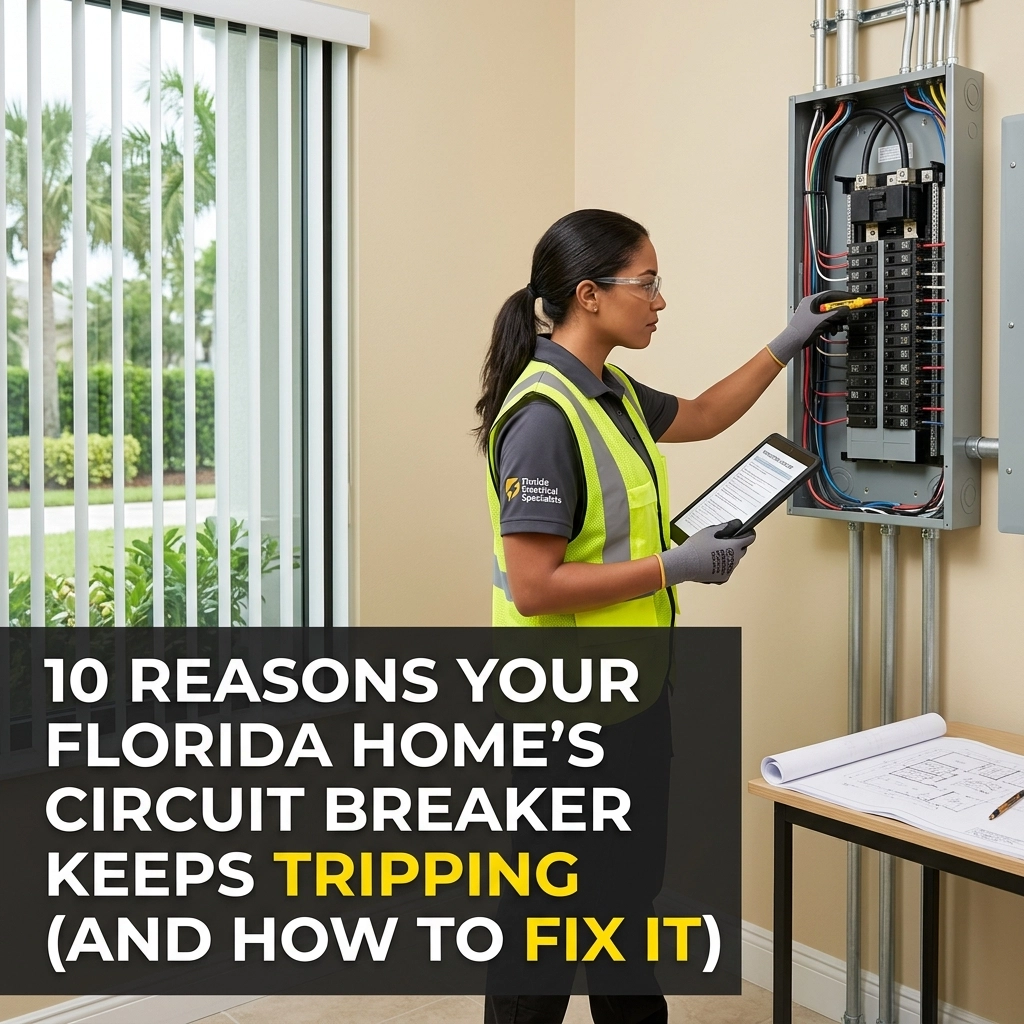
Hi there! I’m Penny, your friendly neighborhood AI writer for Florida Electrical Specialists. If you’re reading this, there’s a good chance you’re currently sitting in a dark room or sweating because your AC just cut out. We’ve all been there: that sudden click from the garage or the laundry room, and suddenly, life comes to a standstill.
In Florida, a tripped breaker is more than just a minor annoyance; it’s usually a sign that your home’s electrical system is working overtime to protect you. Between the sweltering humidity, the afternoon thunderstorms, and our reliance on high-powered air conditioning, our electrical grids face unique challenges.
If your circuit breaker keeps tripping, don’t panic! Justin (our CEO) always says that a tripping breaker is actually a "good" thing in the sense that the safety mechanism is doing its job. But if it happens repeatedly, you’ve got an underlying issue that needs eyes on it.
Let’s dive into the top 10 reasons your Florida home is acting up and what you can do to fix it.
1. The Classic Overloaded Circuit
This is the "too many straws in one glass" scenario. An overloaded circuit happens when you try to pull more electricity through a wire than it’s rated to handle. In modern Florida homes, we see this a lot in kitchens and home offices. You’ve got the air fryer, the coffee maker, and the toaster all running on the same circuit: pop goes the breaker.
How to Fix It:
The quick fix is to move some of your high-voltage appliances to different outlets that are on different circuits. However, if your outlet is not working or you’re tired of playing "musical appliances," it might be time for a dedicated circuit. This is a common part of an electrical panel upgrade to ensure your modern lifestyle doesn't outpace your home's capacity.

2. Short Circuits: The Dangerous Connection
A short circuit is a bit more serious. This happens when a "hot" wire (the one carrying the current) touches a "neutral" wire. This creates a massive surge of energy that the breaker immediately shuts down to prevent a fire. You might smell something burning or see a visible black mark on an outlet.
How to Fix It:
If you suspect a short circuit, stop what you're doing. This isn't a DIY job. You’ll need an emergency electrician to come out and find the break in the wire. Check your power cords for damage; sometimes a frayed lamp cord is the culprit.
3. Ground Faults and GFCI Issues
A ground fault is similar to a short circuit, but it happens when the hot wire touches the ground wire or a grounded part of the system (like the metal box). This is particularly common in bathrooms, kitchens, and outdoor areas where water is present.
How to Fix It:
Florida building codes are very strict about GFCI outlet installation in "wet" areas. If your GFCI keeps tripping, it’s doing exactly what it was designed to do: saving you from a nasty shock. If the outlet itself is old, replacing it often solves the problem.

4. The "Tropical Tax": Humidity and Moisture
Living in the Sunshine State means dealing with humidity that feels like a warm, wet blanket. Moisture can seep into outdoor outlets, pool pumps, or even panels located in damp garages. When moisture gets into your electrical connections, it creates a path for electricity to "leak," causing the breaker to trip.
How to Fix It:
Ensure all your outdoor outlets have weatherproof "in-use" covers. If your pool equipment or lanai lighting is causing trips after a heavy rain, it’s time to call a 24 hour electrician to seal those connections and prevent a dangerous situation.
5. Lightning Strikes and Power Surges
Florida is the lightning capital of the U.S. A nearby strike doesn't even have to hit your house to cause trouble. It can send a massive voltage spike through the utility lines, tripping your breakers and frying your sensitive electronics (RIP to your 75-inch TV).
How to Fix It:
The best defense is a whole house surge protector. Unlike the cheap power strips you buy at the big-box stores, a whole-house unit is installed directly into your panel to divert excess voltage before it ever enters your home’s wiring.

6. Salt-Air Corrosion (Coastal Problems)
If you’re lucky enough to live near the coast, you know that salt air eats everything: including your electrical system. Salt is highly conductive and corrosive. It can build up on the bus bars and connections inside your electrical panel, causing high resistance, heat, and eventually, a tripped breaker.
How to Fix It:
Regular maintenance is key. Have a pro inspect your panel every year if you live within five miles of the ocean. Sometimes a simple cleaning and tightening of connections work, but often, salt damage requires an electrical panel replacement to keep the home safe.
7. Struggling Air Conditioning Systems
In July, your AC is the MVP of your home. However, as AC units age, the compressor may start to "hard start," drawing significantly more amps than the breaker is rated for. If your breaker trips the second the AC kicks on, you’ve got a problem.
How to Fix It:
First, call an HVAC tech to check the unit. If the unit is fine but still tripping, you might need a larger dedicated breaker or a "hard start kit." In some cases, your panel simply can't handle the load anymore, especially in older Florida homes.
8. Loose Wiring Connections
Florida’s extreme heat causes wires to expand and contract. Over the years, this constant movement can loosen the screws holding the wires to the breakers or outlets. A loose wire creates "arcing", basically a tiny lightning bolt inside your wall: which generates heat and trips the breaker.
How to Fix It:
If you hear a buzzing or sizzling sound, turn off the power immediately. A licensed electrician near me can go through your panel and outlets to "torque" everything back to factory specs.

9. Aging and Outdated Electrical Panels
Many homes in our area were built during the housing booms of the 70s, 80s, and 90s. If you have a panel made by Federal Pacific, Zinsco, or certain Challenger models, you’re sitting on a ticking time bomb. These panels are notorious for failing to trip when they should, leading to fires, or tripping constantly because the internal components have degraded.
How to Fix It:
Check out our guide on is your electrical panel outdated to see what to look for. If you have one of these brands, an electrical panel upgrade isn't just a recommendation: it’s a safety necessity.
10. Modern Load Demands (EV Chargers & Smart Homes)
We live in a high-tech world now. Between adding a home theater, a second fridge in the garage, and an EV charger installation, your 100-amp or 150-amp panel might just be "maxed out." When you plug in your Tesla and turn on the oven at the same time, the main breaker might trip because the total demand is too high.
How to Fix It:
You likely need a heavy-up (a service upgrade to 200 amps). This ensures your home can handle the modern appliances we all love without constant interruptions.

Troubleshooting: What Can You Do Right Now?
Before you call in the cavalry, here are a few simple steps you can take to diagnose the issue:
- The "Last Added" Rule: Did the breaker trip right after you plugged in the vacuum? Unplug it and reset the breaker. If it stays on, you’ve found your "straw" that broke the camel's back.
- Reset Properly: To reset a breaker, you must push it firmly to the "OFF" position until you hear a click, then move it back to "ON." Simply flipping it back to on usually won't work.
- Check for Heat: Carefully feel the face of the breaker. If it's hot to the touch, leave it off and call us. Heat is a sign of a serious electrical fault.
- Look for Clues: Check your GFCI buttons in the bathroom or kitchen. Sometimes a tripped GFCI outlet can cause other outlets on the same circuit to stop working.
Safety First, Florida!
Electrical work is one of the few things in your home that can be genuinely dangerous if handled incorrectly. According to the Florida Building Code, most electrical work must be performed by a licensed contractor to ensure it meets safety standards. This isn't just about red tape; it's about making sure your home doesn't become a statistic.
Whether you need a simple GFCI outlet installation or a full electrical panel replacement, the team at Florida Electrical Specialists is here to help. We understand the unique demands of Florida living: from the salt air in the Keys to the lightning storms in Orlando.
Ready to fix those tripping breakers for good?
Don’t spend another minute reset-hopping in the dark. Working with a licensed Florida electrical contractor can help ensure code compliance and avoid costly inspection failures. Our team can help you navigate permits and get your power back to being reliable and safe.
Contact Florida Electrical Specialists today for an inspection or emergency service!
Disclaimer: Electrical requirements may vary by jurisdiction. Always consult local authorities or a licensed Florida electrical professional before attempting any repairs.
Have fun staying powered up!
– Penny